![Ironclad Brand Strategy [logo]](/images/logos/ours/ironclad-logo.svg)
What are the most elusive qualities of the best brands?

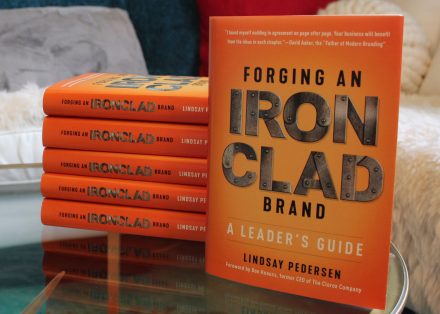
In my book Forging an Ironclad Brand, I write of the 9 criteria for a brand to be "ironclad." They are:
- Big enough to matter
- Narrow enough to own
- Asymmetrical
- Empathetic
- Optimally distinct
- Both functional and emotional
- Sharp-edged
- Has teeth
- Delivers
The three most elusive for most businesses are numbers 3, 7, and 8 -- asymmetrical, sharp-edged, and have teeth. So, let’s explore these three qualities one by one.
3. Asymmetrical: you need a right to win
The path to any value-creating business is ownable differentiation. If you are not different, then you do not have a sound business. You will always be competing on price and time, which will erode your margins.
So, your business must lean into your customer-meaningful asymmetrical advantage. Where do you have a right to win? Where is there a structural, non-copyable advantage? Something that you — and only you — can accomplish? (Hint: Unless you enjoy the lowest cost structure in your category, then you lack a right to win on low prices. Low pricing is not your asymmetrical advantage.)
Consider Chipotle. Fast food competitors own various positions – most ubiquitous, most speedy, most cheap, most loved by kids. Chipotle lacked a right to win on all of those, but they saw that they could win on superb quality food. They could wield their asymmetrical advantage stemming from their relationships with farmers, and their resulting ability to source organic, sustainably farmed ingredients. This structural advantage enables Chipotle a right-to-win on quality, giving Chipotle asymmetry.
7. Sharp-edged: you need to be easy to perceive
To inspire customers to engage with you and buy from you, you need to maximize their cognitive ease. Make it easy for them to see you, use you, and talk about you.
This is why brands with sharp edges more easily engage customers – it’s easier for customers to engage with sharp-edged brands. Think of how much easier it is for your eye to identify something when there is a sharp contrast around its shape. And think of how your eye has to labor when the edges are blurry.
Sharp-edged brands make clear to customers what the business is, and what the business is not. This provides an easy doorway to walk through, so that you are not making them labor in search of it.
Consider a few car brands. You say Volvo, and I say “safety.” Very clear. I know that Volvo is about safety. NOT about sexy, NOT about prestige, NOT about speed.
Or take Jeep. Jeep equals adventure. It is not speedy or racy. I could not slap the Jeep logo onto a 2-seater-sports car. That’s because Jeep’s brand has sharp edges.
And for a brand with blurry edges: Buick. What even is Buick? I’m not really sure. When I look at Buick, it gives me few clues what the brand is NOT, so it’s hard to grasp exactly what it IS. While I can easily SEE the sharp-edged Volvo and the sharp-edged Jeep, I cannot quite see the blurry-edged Buick.
8. Needs to have teeth: you need to be credible
Your brand needs to be anchored in hard fact. This could be an attribute, a feature, or a unique competency that demonstrates why a customer should believe your promise. Without teeth, your brand promise lacks credibility.
Take Chipotle again. Their promise is superb quality. Their teeth are “organic, sustainably farmed sources.” Superb quality is too ethereal to believe on its own. But when I learn that all ingredients are organic and sustainably farmed, I can believe that the food is superb quality.
And consider Nordstrom. Nordstrom is known for its customer service, which is anchored in an astonishingly generous return policy. They will even accept returns of items already worn! Nordstrom’s generous return policy makes their customer service promise believable. It gives the promise teeth.
Here’s a brand promise that lacks teeth: United Airlines promises “it’s time to fly.” But their on-time record is no better than anyone else’s, and they lack much control over prompt flights. That was a failed brand promise, not because it wasn’t customer-meaningful (customers very much appreciate on-time flights), but because there was no demonstrable proof of its truth. It lacked teeth.
Not all brands are equally value-creating. The ones that create the most value are the ones that lean into an asymmetric advantage; that present sharp edges; and that demonstrate credibility with teeth.
For any business, you’re going to have a brand. As the saying goes, “position or be positioned.” It’s only a question of whether you allow the brand to be created passively or whether you consciously shape it. Consciously shaping your brand improves the chances that the result will unfurl your highest value.
Topics
Looking to improve your business through brand strategy?
Sign Up for Our NewsletterYou May Also Like…

How do brands create value by caring?

What’s the logic behind the rebranding of the Mormon Church?

What should I be aware of before doing a brand strategy?
How does our brand harness storytelling?

Who chooses your brand’s position?

What is the role of value in my brand?

What is the #1 secret weapon for brand building?
Why I Wrote a Book About Brand
What can we learn about brand from the explorer Sir Ernest Shackleton?